Whenever I say I’m a meditation teacher, it almost always comes up. “Well, can you get rid of my stress? Can you give me ultimate peace?”
No. But what I can do is help you turn the volume knob down a little, on the world and on your thoughts, and give you a little space between what’s happening inside you and what’s happening in the world. Enough that your life feels a lot more peaceful.
You don’t need fixing. You’re perfectly human. What you need is the instruction manual for how your mind and body work. Then we can take a step back and reduce the suffering a little, and a little more, until the dramas in your life come round a lot less often. You’re less reactive and more in control, with the freedom of knowing peace was there all along. Now you know how to tap into it.
And yes, just ten minutes a day can really help move you in that direction. The newest studies back that up, once you take the hype out.
Does meditation actually work?
Yes. Modestly.
A big review in the journal Mindfulness in 2026 pooled 132 randomised trials with nearly 14,000 people aged 18 to 30. Mindfulness courses eased anxiety, low mood and stress.
But read the small print. Compared with doing nothing, the benefit was decent. Compared with other things that help, like relaxation classes or counselling, the gap shrank to small. And the most carefully run studies found smaller benefits than the rest.
Mindfulness is a good tool, not a magic one. I’d rather you knew that on day one than felt cheated on day thirty.
Is there a best type of meditation?
In November 2026, BMC Psychology published a trial of 1,211 adults. Each was randomly given four weeks of app guided meditation (loving kindness, mantra, body scan or nondual awareness) or the same time listening to classical music.
None of the meditation styles beat the music. None of them beat each other either.
More than half the people had dropped out before the final measures, which the authors say makes the result less certain.
So stop hunting for the perfect technique. The hard part is keeping going, and that’s the bit you can do something about.
How long should a beginner meditate?
A trial in JAMA Network Open in 2025 split 1,458 staff into two groups. Three quarters had never meditated. Half got a meditation app and were asked for ten minutes a day for eight weeks. The other half waited. The app group’s stress dropped far more, and the drop was still there four months later.
In the app group, those who managed five to ten minutes a day did better than those who managed under five. That’s a pattern, not proof, because people chose how much they did. But it’s the number I’d hold on to.
Two honest caveats. The app company helped fund the study, and the comparison group did nothing at all. Even so, five minutes of meditation most days is a real start. You don’t need an hour on a cushion.
What if meditation makes me feel worse?
It might, for a moment.
A 2026 paper in JMIR Mental Health followed stressed adults new to meditation through an app programme. Depending on how the question was asked, between one in ten and about one in four said they’d had a difficult or distressing experience they put down to meditation. In the first trial, the most common were a rush of anxiety or a stressful memory coming back. Between three and seven in a hundred said it got in the way of daily life, mostly for a day or less.
In the second trial, about fifty people barely meditated at all, yet reported these experiences about as often as everyone else. The authors take that as a sign that some of these hard moments come from what people were already carrying.
Meditation doesn’t put the storm there. It just stops you running long enough to notice it.
About nine in ten of those who had a hard moment were still glad they’d done it.
So if something difficult comes up, you haven’t broken anything. Open your eyes and go gently. If it keeps happening, or it’s tied to trauma, talk to your GP or a teacher who knows this ground.
Try this today: a five minute meditation for beginners
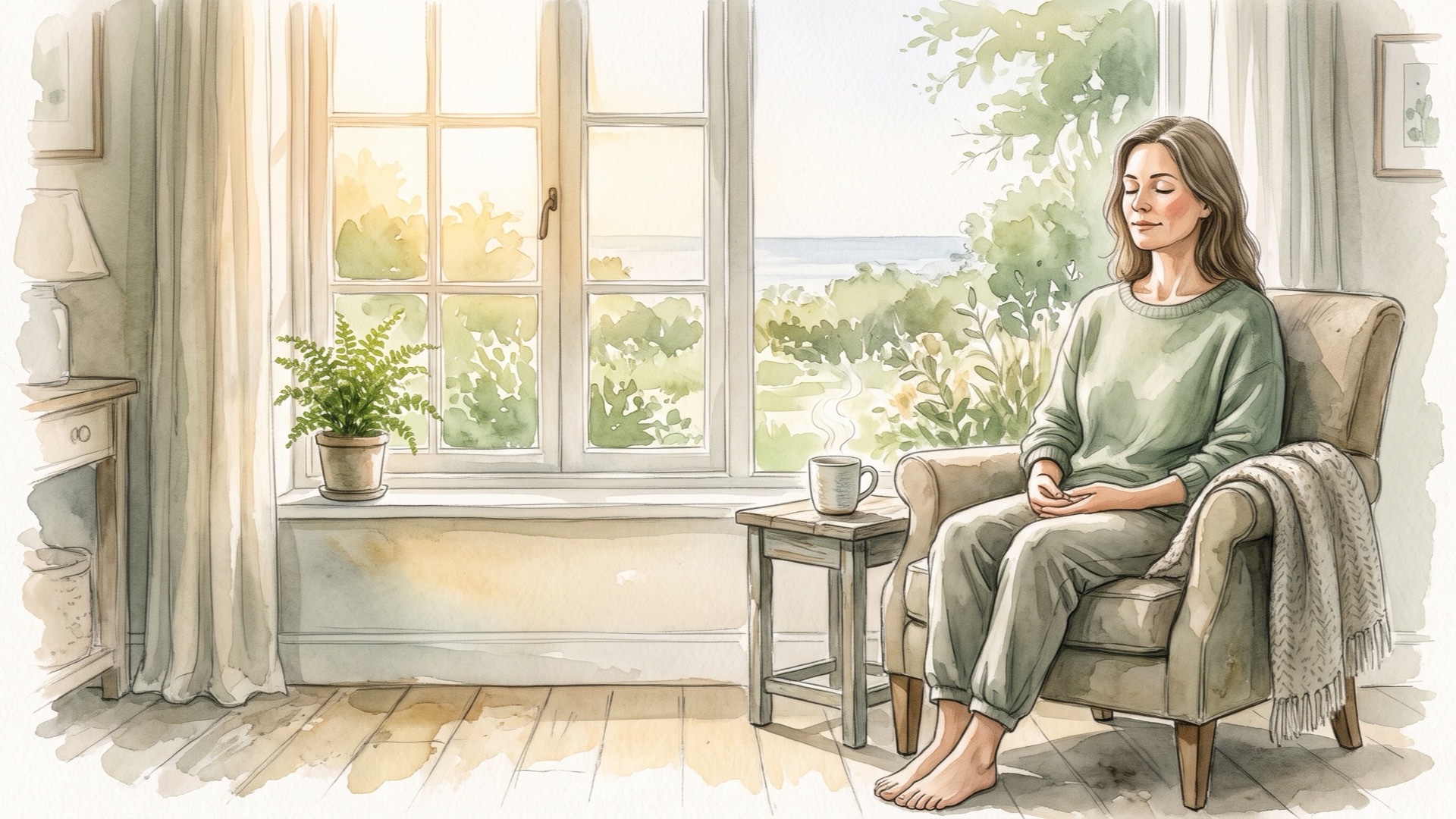
A chair is fine. So is a bed.
- Sit or lie however is comfortable, and set a timer for five minutes.
- Let your eyes close, or rest them softly on the floor.
- Feel where you’re held. The seat under you, or the mattress.
- Find the breath wherever it’s easiest to feel, the nose or the belly. Don’t fix it. Just notice it.
- When your mind wanders, and it will, notice where it went and come back. That coming back is the practice, not a mistake.
- When the timer goes, pause for one more breath before you move.
Same time tomorrow.
You won’t feel calm every time. Some days it’ll feel like sitting in a washing machine. Do it anyway. Five minutes, done badly, still counts. We’re all terrible meditators, and I’ve a whole episode of my Stillness in the Storms podcast about it.
If you’d like a voice to sit with while you start, my Inner Peace Meditations are on the podcast, Insight Timer and Aura. Pick a short one and press play tomorrow morning.
The studies, so you can find them
- Mindfulness, 2026. Seneviratne and colleagues, a review of 132 randomised trials of mindfulness programmes in young adults. Read it
- BMC Psychology, 2026. Wahbeh and colleagues, a trial comparing four types of app meditation with classical music in 1,211 adults. Read it
- JAMA Network Open, 2025. Radin and colleagues, a trial of digital meditation for employee stress in 1,458 staff. Read it
- JMIR Mental Health, 2026. Beloborodova and colleagues, two trials on difficult experiences during app meditation. Read it